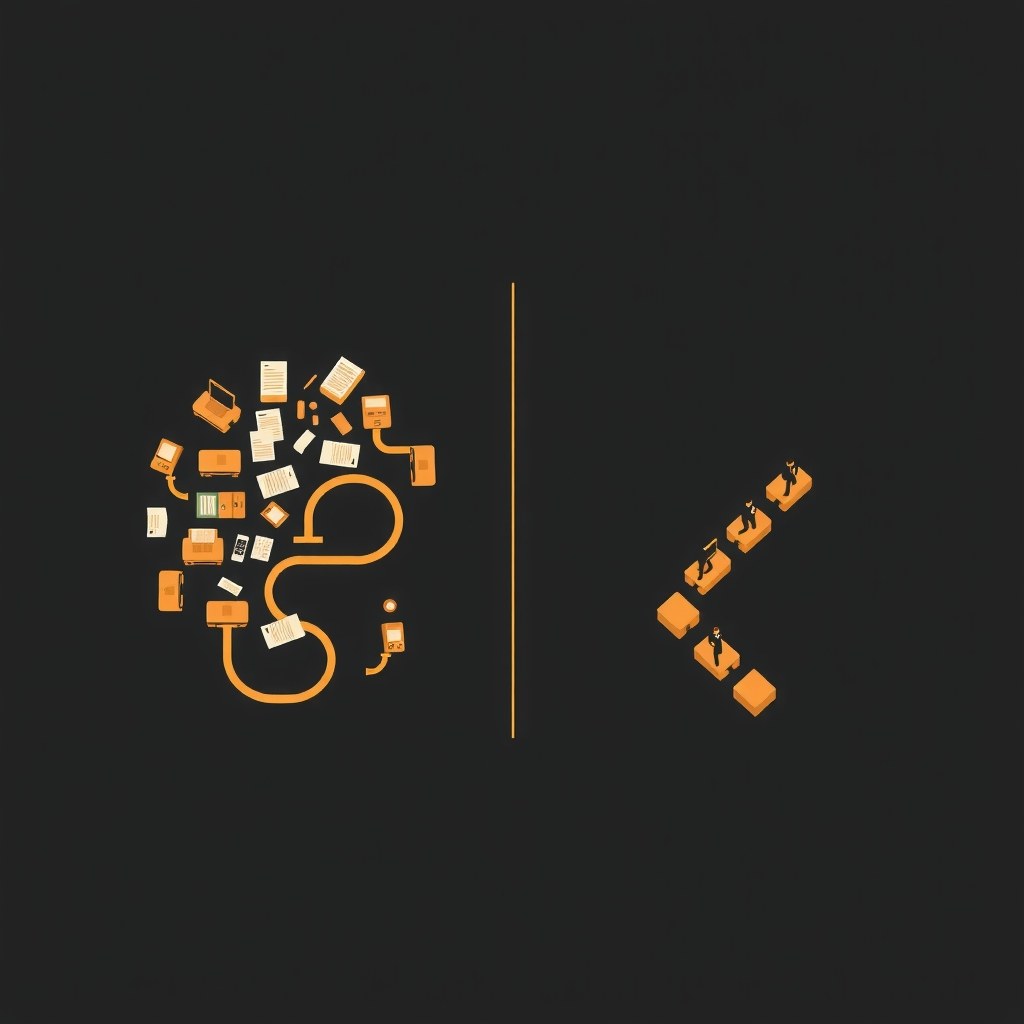
Many organizations bring AI into their operations in the same order. They choose a tool, run a pilot, and only then look closely at the process the tool is meant to improve. By that point the decision is made, the budget is spent, and the process is treated as a given.
The order matters more than the tool. Most AI deployed in operations is set up to work inside an existing process, not to question it. It handles that process faster and at larger volume. A clear, well-designed process gets faster. A process full of unnecessary steps, unclear rules and manual workarounds produces the same problems faster, at scale, and in output that looks finished enough that fewer people question it.
Why the Tool Usually Comes First
There are understandable reasons. Technology has a budget line, a vendor and a launch date. Process work seldom has any of these. It is slow, it often has no clear owner, and its results are hard to show in a presentation.
Vendor demonstrations add to the pull. A demo shows the ideal version of a workflow: clean inputs, one approver, no exceptions. The real workflow in many organizations looks different. Requests arrive in three formats, two approvers sign off on everything, and a large part of the work happens in email threads and spreadsheets that no system can see.
There is also a structural reason. In many organizations, no one owns a process from start to finish. Finance owns one step, programs own another, procurement owns a third. Each team can describe its own step. Few people can describe the whole process, and fewer still have the authority to change it.
What Automating a Broken Process Actually Does
When AI is added to a process that has not been examined, several things tend to happen.
Unnecessary steps become permanent. An approval chain with five sign-offs, two of which add nothing, becomes a faster approval chain with five sign-offs. Automation makes the extra steps cheaper to run, which removes the pressure to question them.
Errors spread further. If the same information is entered twice in different systems, automation carries the inconsistencies between them into every report, dashboard and decision that draws on that data.
Workarounds become rules. Staff often keep a process working through informal fixes: a spreadsheet that corrects a system’s output, a colleague who knows which requests to prioritize. When AI replaces that process or learns from it, the workaround is either lost or built into the system as if it were the intended design.
And problems become harder to see. In a manual process, people notice when something looks wrong. As fewer people touch the work, fewer people are in a position to notice. Output that is fast and well formatted carries an authority it has not earned.
Five Questions to Answer Before AI Goes In
The fix is a matter of order. Before AI is added to any process, five questions deserve a clear answer.
- How does the process actually work today? Not as documented, but as done. Walk through it with the people who carry it out, and record every step, handoff and workaround.
- Where does work wait? In many processes, more time is lost in the queues between steps than in the steps themselves. Measure waiting time and working time separately to find the real bottleneck. Speeding up a task that is not the bottleneck changes very little. The mapping methods in our earlier piece on Lean techniques are built for this.
- Which steps can be removed entirely? A step that adds no value should be removed before automation, not after. Separate waste from control first: a second signature required by a donor, an auditor or a segregation of duties rule is a control, and it stays. Removing a genuine duplicate costs less than automating it and then maintaining the automation.
- Where must a person still decide, and on what basis? Define each human checkpoint by role, and write down what the person is checking for. A checkpoint without criteria becomes a click.
- How will you know it worked? Measure cycle time, error rates and rework before the change. Without a baseline, any result can be presented as a success.
The Missing Role: A Process Owner
Most of these questions cannot be answered without a role that many organizations lack: a process owner. This is a person accountable for how a process performs from beginning to end, across every team it passes through, with the authority to change it.
Without an owner, AI projects default to the team that bought the tool. That team improves its own step and leaves the handoffs untouched, and the handoffs are where most of the delay and most of the errors sit. With an owner, the organization has someone who can decide which steps go, which rules apply and where human judgment stays. The same person is the natural owner of the AI system once it is in place, which closes a gap that governance reviews often find too late.
The Order That Works
A sequence that tends to hold up is simple. First simplify the process. Then standardize it, so the same work is done the same way each time. Then automate the routine parts, testing each change in a small pilot before it is scaled. Only then add AI where it does something rules alone cannot: sorting large volumes of requests, drafting first versions of documents, spotting patterns in data that people would miss.
Organizations that follow this order gain twice. A simpler process costs less to run whether or not AI is ever added. And the AI they do add works better, because it runs on clean inputs and clear rules.
The useful question for leaders is therefore not “where can we use AI?” It is “which of our processes is ready for it?” Answering that honestly takes longer than buying a tool. It is also the difference between automation that improves an organization and automation that hides its problems.